Nikon Z 100-400 mm f/4.5-5.6 VR SThis page discusses the Nikon Z 100‑400mm f/4.5‑5.6 VR S, introduced in 2021 and still marketed. It was the first super‑telephoto zoom in the Nikon Z system, and to‑date remains probably the best and most versatile telephoto zoom in this system (e.g. see review by Ken Rockwell). It is a relatively large (222 mm minimum length, 271 mm fully extended), relatively heavy (1.44 kg with tripod foot) and expensive zoom of excellent optical and mechanical quality. Nikon positions this zoom as an S‑line lens, a denomination reserved for the best Nikon glass. The front of the 100‑400 mm extends when zooming toward longer focal lengths, but the center of gravity of the lens does not change. The zoom mechanism does not glide under the effect of gravity when pointed up or down, and the force necessary to zoom it in or out does not change when the lens is pointed up or down. When extended, the front part of my specimen shows no sign of wobbling. Features

As shown in the above figures, with a heavy camera like the Z8, the lens and camera are rear-heavy, especially with an added camera bracket or cage. With a lighter camera and no camera bracket or cage, the balance is better, with the center of gravity located directly above the tripod shoe. The lens collar is equipped with a removable tripod foot, but the collar itself cannot be removed from the lens. In true Nikon style, the tripod foot is not equipped with Arca‑compatible grooves. This foot is the same one used in a number of other Z lenses, including the 600 mm PF, and can be replaced with a third‑party one (e.g. iShoot) equipped with an integral Arca-compatible shoe. Alternatively, you can attach a thin Arca plate at the bottom of the original tripod foot. Neither the lens collar nor its shoe are equipped with eyelets for a carrying strap, in spite of the lens being heavy enough to make it unwise to leave it dangling from the lens mount of the camera. Removing the lens shoe reveals a proprietary shoe attachment equipped with a 1/4-20" threaded socket. Most of the time, when carrying this type of lens, I use it hand-held, and pack it in my camera bag without its foot. Instead, I attach a neck strap to the threaded socket at the bottom of the lens collar. The maximum barrel diameter is 98 mm (not including lens shade and tripod collar). The reversed lens shade, tripod shoe and two large knobs on the lens collar take additional space in a camera backpack. Optics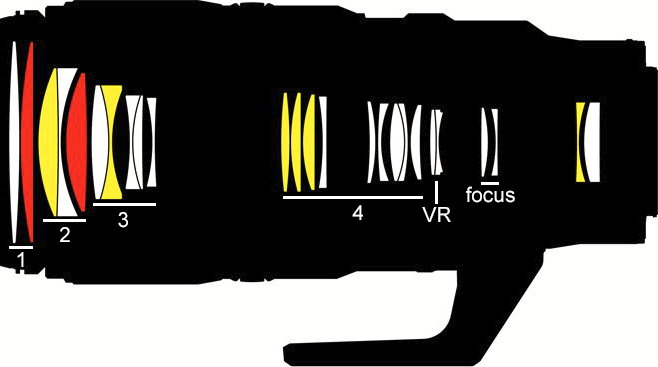
The above figure shows the optical scheme of the 600 mm. This lens uses 25 elements in 20 groups, of which two SED (Super Extra‑low Dispersion) elements (red) and 6 ED (yellow). This is probably the most complex optical scheme among the lenses I am currently using. The lens coatings are also sophisticated, with SIC, Nano and Arneo coatings used on different elements. In optics construction, the term group is generally used to indicate two or more optical elements (i.e. physical lenses built from a single piece of glass) permanently cemented together. In the camera lens literature, the term group is instead often applied also to a number of elements not cemented together, but held in fixed reciprocal positions by a metal or plastic barrel, which in principle could be taken apart. I prefer to call this entity subassembly. Patents JP,2022-092388,A and WO2021131369A1 show that zooming changes the reciprocal spacings of four optical subassemblies, independently of each other. The subassemblies contain the following elements, counting from the lens front:
The lens aperture, located between elements 14 and 15, moves as part of subassembly 4. VR controls a doublet (elements 20-21) located at the rear of subassembly 4, which also moves with the latter subassembly. At the rear of the VR group, two more elements (22-23) control focusing. The rearmost subassembly of two elements (24-25) does not move. Zooming is mechanical and manually operated. This lens is not equipped with a fixed meniscus protector filter. As far as I know, Nikon stopped using this feature even on top-of-the-line lenses, and no Z lens has it. In principle, a cracked protector filter can be cheaper to replace than a cracked front element. In practice, however, both procedures are so expensive as to be economically unjustified in most cases. Long telephoto lenses are today less expensive than in the past, and many professional photographers do insure their most expensive and most necessary pieces of equipment. Filter mountThe filter mount is 77 mm. There is no provision for internal or rear-mounted filters. The filter mount is made of plastic. With reasonable care not to damage the thread on the filter mount by forcing a skewed filter to screw in, it should last many years. Quite a few other Nikkor S lenses also have plastic filter mounts. If you frequently change filters and are concerned about wear of the plastic filter mount, you can screw an empty metal 77 mm filter ring into the filter mount of the lens, and leave it permanently there. When you need to mount a filter, screw it into this empty filter ring. On a telephoto lens, an extra filter ring should cause no detectable vignetting, and increases the lens length by only a few mm. TeleconvertersThis lens accepts the Nikkor Z TC‑1.4x and TC‑2.0x teleconverters. See below for tests with both teleconverters. FocusingFocusing is internal, powered by two stepper motors. I do not know for sure why there are multiple motors in this lens, but the 100‑400 mm is in no way unique in this (e.g. I am aware of a recent Sony lens that uses four motors). It seems reasonable to me that using multiple motors allows a degree of optimization not feasible with a single motor controlling a set of mechanical cams. The optimal positions of the two focusing optical elements likely change at each combination of focus distance and focal length. This would be too difficult to achieve with purely mechanical cams and sliders, but is easily achieved by the lens processor IC controlling the two motors. This lens is equipped with two control rings with different sculpturing. The ribbed one, by default, operates as a manual focus ring by‑wire, but its function can be reconfigured in the camera menu if desired. The other control ring (the thinner, knurled one) is better used for a different function, e.g. ISO, Auto ISO, or even lens aperture. With a long and heavy lens in my hands, changing the lens aperture by rotating a stiff secondary dial on the camera body makes my view of the subject jump wildly, and I must move my index finger away from the shutter button to do this. A click-less control ring, instead, lets me adjust the aperture with my left hand without waving the lens around and without moving my index finger away from the shutter button. No distance scale is printed on the lens barrel, but both the camera and the small LCD screen near the lens mount can display the current focus distance. Closest focus is 0.75 m at 100 mm focal length, and 0.98 m at 400 mm, with a maximum magnification of 0.38x. This is handy for close‑up imaging of relatively small skittish subjects. In reasonably good light and with a subject that does not move too fast, VR allows this lens to be used hand‑held at all focal lengths. The AF speed of a long telephoto lens is a critical performance parameter, especially in wildlife photography. AF on this lens is both fast and accurate (at least, when no teleconverter is used). ZoomingThe zoom ring rotates slighly less than one-quarter of a turn. The lens speed changes gradually throughout the zoom range. The following table shows how the lens speed, as reported in the EXIF data, changes with focal length.
Lens controlsAside for the focus ring and the two configurable control rings, this lens is equipped with several round buttons and two sliders. Focus mode slider
Focus limit slider
L-Fn buttonThis button can be configured. L-Fn2 buttonsFour of these buttons are placed around the lens barrel, between the zoom and focus rings. The same configured function applies to all four buttons. They cannot be individually configured. Security cable socketA hidden feature is present under the rubber cap of the knob used to lock the lens collar. Pulling out this cap reveals a socket that can be used to attach a security steel cable, to be fastened to something large and heavy. It may come in handy when this lens is exposed in a camera shop and available for customers to try out the lens controls and feel. Possibly some event, sports and news photographers who routinely use this lens in public places may find it useful, too. VRThis lens has no hardware control for configuring VR. This function can be controlled via the camera menu or the "i" control panel, or a suitable custom control can be configured for this function. LCD displayLike several other S-series lenses, the 100-400 mm is equipped with a small LCD display. Several users of these lenses have questioned the usefulness of this LCD display. The same information can also be displayed on the camera's LCD screen or, when present, the top camera LCD display. Weather sealingThis lens is fully weather sealed. However, the extending lens front means that air is pumped into and out of the lens interior every time the lens is zoomed, carrying humidity and possibly fine dust. In practice, weather sealing only gives some protection against falling rain (albeit not water jets or immersion in a liquid), but the lens is still vulnerable to sand, salt spray, and fine dust. Lens shade
The 100‑400 mm comes with the deeply scalloped HB‑103 lens shade. In practice, this lens shade is designed to avoid vignetting when using the lens at 100 mm, and relies on the lens coatings to avoid flare from off‑center light passing through the deep notches in the lens shade at higher focal lengths. The lens shade attaches to a plastic bayonet located around the extending front of the lens. Like the lens shades of other Z long telephoto lenses, the HB-103 is unlocked by pressing a small rectangular button on the base of the lens shade. This button is difficult to locate by touch, even when not wearing gloves, and the lens shade can be mounted in two different orientations. You may try to form a habit of putting on the lens shade always in the same orientation, to avoid hunting for the unlocking button when it is time to remove the lens shade. When reversed, the HB-103 locks at a different rotational orientation than when mounted in the forward orientation. The reversed lens shade makes it practically impossible to operate the zoom ring. Place of manufactureThis is one of the few current Nikon lenses made in Japan. Often, current and recent Nikon‑branded camera lenses produced in Japan are not actually made in a Nikon factory, but instead are made in Japan for Nikon by other companies, especially Tamron. Some specialty lenses are made by Tochigi Nikon. In the past, a few Nikon-branded lenses were cosmetic adaptations of pre-existing third-party lenses, most often Tamron (e.g., the AF Nikkor 14 mm f/2.8 D). As far as I know, this is not the case of any Z lens. Tamron does make a few models of Tamron-branded lenses in Z mount, but a contractual agreement with Nikon prevents Tamron from marketing Tamron-branded lens models that directly compete with Nikon-branded Z lenses. A comparable agreement probably exists between Nikon and Sigma. The latter is marketing a few Sigma-branded Z lens models. TestThe test subject is a pavement of garden concrete bricks outdoors, photographed from four floors up. All test images were shot hand‑held with a Z8 at ISO 200 and the 100‑400 mm at 100 mm, 240 mm and 400 mm. Test at 100 mm: 
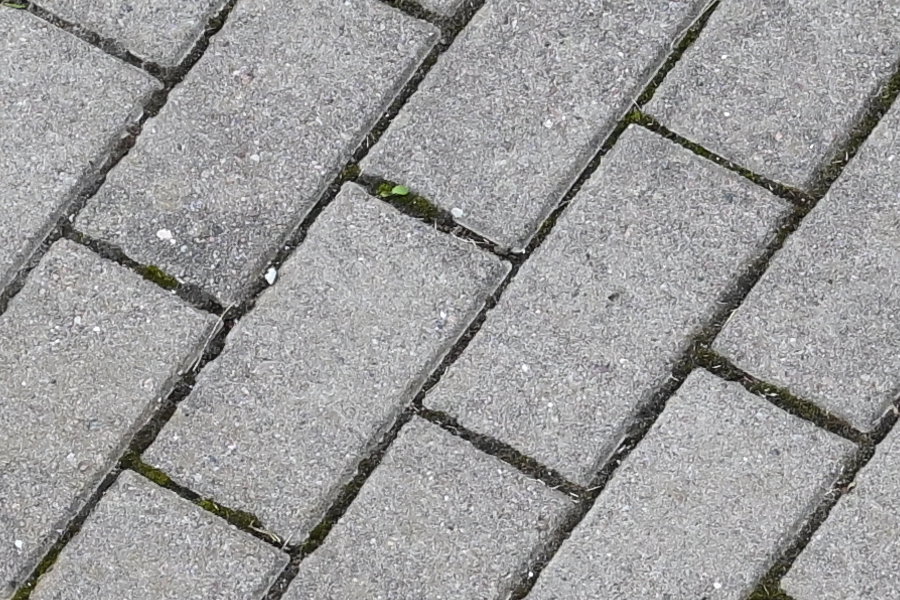


At 100 mm, contrast suddenly changed at f/11. I believe this was caused by a sudden cloud covering the sun. Other than this, image resolution is good and fairly constant up to and including f/11, and only slightly lower at f/16. Test at 240 mm: 


At 240 mm, there is a very slight loss of resolution at f/11, and a more perceptible one at f/16. Test at 400 mm: 


At 400 mm, the tests show a very slight loss of resolution at f/11 and slightly more at f/16. Finally, tests with the TC-1.4x and TC-2.0x teleconverters. Test at 400 mm + 1.4x teleconverter (effective 560 mm): 

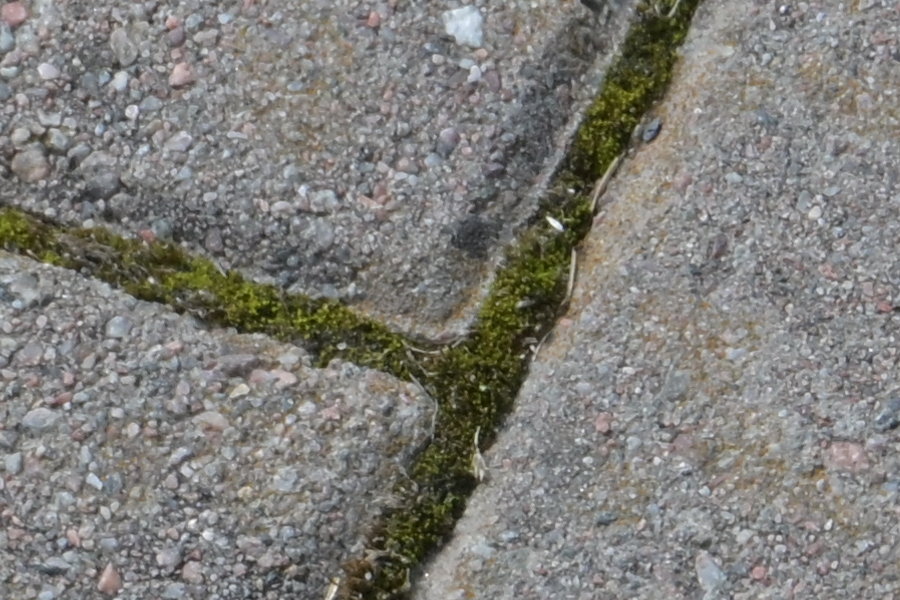
Test at 400 mm + 2.0x teleconverter (effective 800 mm): 

As a whole, the results without teleconverter at all focal lengths and up to f/11 are excellent. They are not always superlative like the results I obtain with the 600 mm PF S, but not far behind. With the TC-1.4x teleconverter and the zoom set at 400 mm (effective 560 mm), the results remain excellent between effective f/8 and f/11. As long as there is enough light, I would not hesitate to use this teleconverter with the 100-400 mm. With the TC-2.0x teleconverter and the zoom set at 400 mm (effective 800 mm), the results are excellent at f/11 to f/16. In fact, they are very slightly better at f/16, perhaps because the 100-400 mm with this teleconverter begins to show its limits when shooting fully open, and stopping down by one stop makes the image quality better. Alternatively, it could be because in the test at f/16 AF happened to nail a perfect focus in the area of interest. This may point to an incipient problem of the Z8 autofocus in setting the perfect focus with an f/11 lens. I would prefer to use the 600 mm PF and TC-1.4x (or TC-2.0x if a 1,200 mm focal length is not excessive) in this case. This lens and the TC-1.4x, together, are a little faster than the 100-400 mm and TC-2.0x, but if I will happen to be in the field with the 100-400 mm and TC-2.0x, I will use them without much regret. During all my previous experience of photography (in total, more that three-quarters of my life), I never before experienced such a good image quality with a long telephoto zoom and a 2x teleconverter. For additional tests of this lens, see e.g. photographylife.com and cameralabs.com. Virtually all reliable reviews I have read agree that the 100‑400 mm is much better than the AF‑S Nikkor 80‑400 mm f/4.5‑5.6 VR, as well as better than the Nikkor Z 180‑600 mm in the shared range of focal lengths (180‑400 mm). Photographylife.com compared the 100‑400 mm at 400 mm with TC‑2.0x teleconverter (effective 800 mm f/11) versus the Z 800 mm f/6.3 and, not surprisingly, found that the Z 800 mm is better. I have yet to see a lens, Nikon or otherwise, that is perfect in all respects with a 2x teleconverter. On the other hand, when the alternative is to go home without a picture, even a slightly fuzzy picture is better. Additionally, when shooting at 800 mm or longer focal lengths, a lot more can go wrong than just the lens not being fully sharp. When I need to do that, I use the Z 600 mm PF with TC‑1.4x instead, which is an effective 840 mm f/9 (I regularly use it hand‑held when the sun shines, and it just works). Alternatives to the 100‑400 mmThere are no close alternatives among current Nikon Z S-series lenses. To find alternatives, one has to move to non-S lenses. The Nikon Z 180‑600 mm is a little weak at 500‑600 mm, and in my experience it does not work well with teleconverters. It is sharp up to 400 mm, but it is much larger than the 100‑400 mm, and the latter is a faster lens, as well as optically better. A new 100‑400 mm at present retails in Europe for 400 to 800 € more than a new 180‑600 mm, an indication that the 100‑400 mm is more expensive to produce. The 100‑400 mm is also several hundred € more expensive than the 180‑600 mm on the second‑hand market. The Nikon Z 28‑400 mm f/4‑8 VR is a consumer lens designed as an all‑in‑one zoom for travel photography, and for this use is typically mounted on one of the "lower" Z cameras, as an alternative to a fixed‑lens super‑zoom camera. It is penalized by a slow lens speed at the higher focal lengths, where a reasonably high lens speed would be an obvious plus. It is not bad in its class, but one cannot really consider it as an alternative to the 100‑400 mm. The AF‑S Nikkor 80‑400 mm f/4.5‑5.6 VR in F mount can be used on Z cameras via an FTZ or FTZ II adapter. It is the only Nikon F zoom of this range of focal lengths that works in AF on a Z camera. The earlier AF Nikkor 80‑400 mm in F mount only works in manual focus on FTZ adapters. Neither lens is as sharp as the Z 100-400 mm. If you already own one of these F lenses and an FTZ adapter, it does not hurt to try them on a Z camera. Although not on the same level as the Z 100-400, they may still come in handy. As the saying goes, you cannot shoot with a lens you don't have, so an adapted 80-400 mm in F mount may not be ideal, but will always be better than no long telephoto lens at all. ConclusionsThe Nikkor Z 100‑400 mm is currently the best long telephoto zoom in the Nikon Z system. The Z 180‑600 mm offers a longer maximum focal length, albeit with a lower image quality in the 500‑600 mm interval of focal lengths. The Z 100‑400 mm is noticeably sharper than the 180‑600 mm throughout their shared zoom range, and has a higher AF speed and reliability, better in‑lens VR, and a much lower physical length and weight (1.14 Kg and 222 mm long at 100 mm). The 100‑400 mm accepts teleconverters and works well with the TC‑1.4x and TC-2.0x, at least when there is enough light. With these teleconverters, it does not perform flawlessly like e.g. the Z 600 mm PF, but still remains excellent. |