Nikon Z TC-1.4xA focal length multiplier is an optical accessory that mounts between a lens and a system camera, and multiplies the focal length of the camera by a fixed factor. The Nikon Z camera system contains two focal length multipliers: the TC-1.4x with a multiplying factor of 1.4, and the TC-20x, with a multiplying factor of 2. The Nikon literature I checked always uses the TC-14x and TC-20x item names. However, at the bottom of each teleconverter the Nikon item name is spelled with a full stop, i.e. TC-1.4x and TC-2.0x. On this page, I use the name as spelled on the actual teleconverter. This page describes my experience with the Nikon TC-1.4x on the 45.7 Mpixel Nikon Z8 camera and the Nikon Z 180-600 mm f/5.6-6.3 VR lens. I discuss the TC-2.0x on a separate page.
Photographers who test these combinations of equipment on a 20 or 24 Mpixel camera may reach different
conclusions than mine. The TC-1.4x in practiceThe TC-1.4x weighs 220 g and adds 19 mm of extension between camera and lens. This is quite a small length, and does not substantially change the lens balance and weight. One thing one immediately notices about Z teleconverters is that they have much larger rear optical elements than teleconverters for Nikon F cameras. This is an unavoidable consequence of the very short registration distance of Nikon Z cameras. Also, the rear optical element is round, but surrounded by a (mostly) rectangular light baffle, in order to allow as much as possible of the light to reach the sensor, but nothing else. These characteristics are also seen in most Nikon Z lenses. The TC-1.4x uses 6 elements (including one aspheric) in 4 groups. 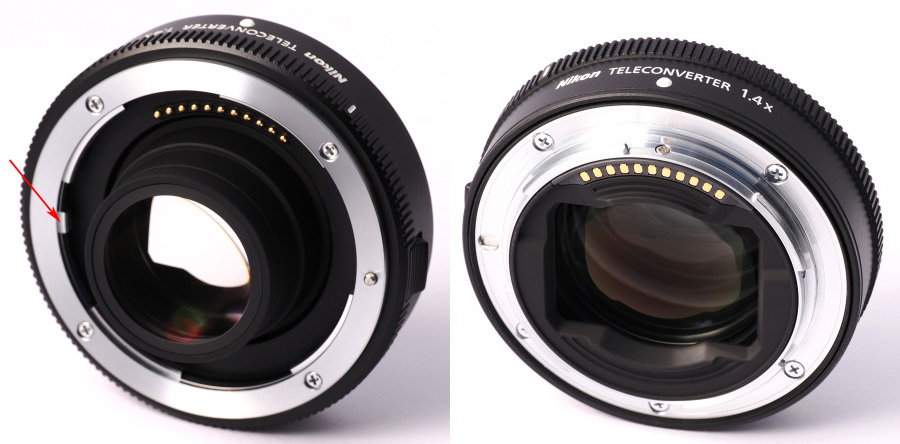
Note that the internal metal barrel of the TC-1.4x protrudes from its front bayonet. This implies that the teleconverter is not compatible with lenses that have optical elements mounted close to their rear bayonet. Figure 1 shows that the TC-1.4x (and TC-2.0x) have an extra lug on their front bayonet (arrow). This extra lug prevents attaching the teleconverter at the rear of a lens that lacks a matching notch for this extra lug. In this way, Nikon prevents photographers from attempting to attach the teleconverter to lenses that are not compatible with Nikon teleconverters. This includes lenses that would work poorly with a teleconverter (for optical reasons), as well as lenses with rear optics mounted too close to their rear lens bayonet (for mechanical reasons). This includes virtually all Nikon Z wideangles, "normal", macro and short telephoto lenses, zoom and primes alike. The Nikon Z FTZ and FTZ II lens adapters lack the teleconverter-specific notch on their rear bayonet, and cannot be used to mount a Z teleconverter on a Nikon F lens. You need to use Nikon F teleconverters on these lenses. Nikon Z teleconverters may further detect electronically that they are attached to a Nikon F CPU lens via a lens adapter, and refuse to work. Nikon uses a very similar extra lug on the front mount of its Nikon F teleconverters, for the very same reasons. The rear bayonet of the TC-1.4x (and TC-2.0x) has no teleconverter-compatible notch. Thus, it is physically impossible to stack two Nikon Z teleconverters on top of each other to obtain a higher focal length magnification factor (not only because of the extra lug, but also, more importantly, for the position of their rear optical surfaces). In the past, consumer and intermediate-level F-mount DSLRs were only capable of autofocus with f/5.6 lenses or faster. In practice, this means that AF was only possible (or at least reliable), on these cameras, with f/2.8 lenses with a 2x teleconverter, or f/4 lenses with a 1.4x teleconverter. Modern DSLRs, especially pro-level ones, changed the f/5.6 lens speed limitation to f/8. However, in all classes of DSLRs, AF is faster and more reliable with faster lenses. Pro-level Z cameras are more tolerant of slow lenses, and in fact always stop down a lens to the aperture chosen by the photographer, or up to f/5.6 (whichever is faster) to meter and autofocus. 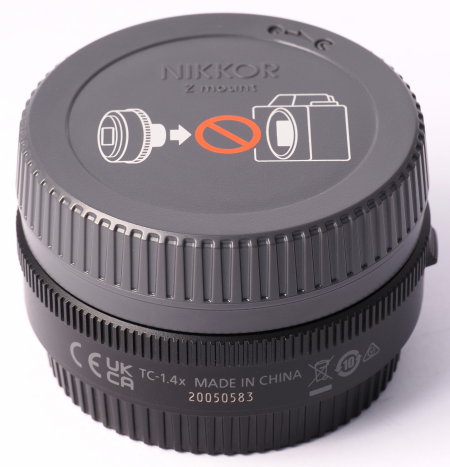
The protruding front optics of the TC-1.4x and TC-20x require a special Nikon BF-N2 front cap for teleconverters (supplied with every Nikon teleconverter, and available for separate purchase if lost). At the front of the BF-N2 is a sketch warning against attempting to mount a teleconverter onto a camera in reversed orientation. Making this by mistake may cause permanent damage (cracking the sensor's filters and the sensor chip itself, putting out of commission the sensor's VR mechanisms, etc.) to the sensor package of a Z camera.
The metal mount of this teleconverter's front elements is surrounded by a rubber grommet, which slightly
lowers this risk. It also lowers the risk of damage to lens and/or teleconverter when attempting to attach
a teleconverter to an incompatible lens. However, it all depends on how strongly and quickly the
teleconverter is brought into contact with incompatible equipment. Doing this carelessly or in a hurry is
a recipe for disaster. There are two ways to mount a teleconverter. Attach it to the lens first, then to the camera. Or alternatively, to the camera first, then to the lens. The final result is the same, but by attaching the teleconverter to the lens first, you eliminate the risk of trying to mount a reversed teleconverter onto the camera. Also, keep in mind that one does not bring a long lens into contact with the camera to attach them together. Instead, one brings the camera to the lens, and turns the camera, rather than the lens, to lock it onto the lens. During this process, the long lens can hang on a strap around your neck if you are standing or, if you are sitting or kneeling, the lens can rest in your lap. It is also a good idea to tilt the lens sideways, so that you can see the mounts of both lens and camera while you are bringing them together. I do not recommend attempting to do so blindly or by feeling your way with your hands. 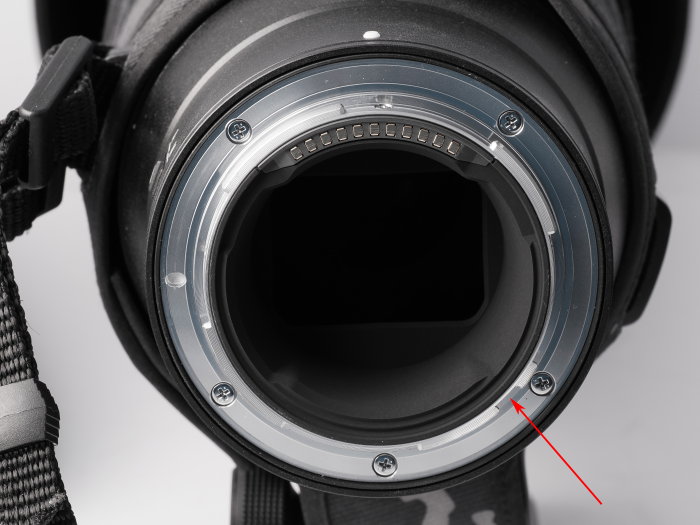
The Z bayonet at the rear of Nikon Z FTZ and FTZ II lens adapters has no teleconverter notch. It is therefore impossible to use a Nikon Z teleconverter with a Nikon F lens adapted for use on a Z camera. In the past, many photographers filed off the extra lug of Nikon F teleconverters, to enable a broader use than sanctioned by Nikon (e.g. to increase magnification in photomacrography). There are reports that Z teleconverters, even after being modified in this way, may be capable of detecting when some unsanctioned lenses and/or accessories (like the FTZ and FTZ II lens adapters) are attached at their front, and prevent the camera from working. In these cases, the live view blanks and an error text message is displayed on the camera LCD. There appears to be no such problem, instead, with lenses not equipped with a CPU. I wonder whether some of the reported compatibility problems are actually caused by defective lens adapters that short-circuit the electrical pins at the front of a Nikon Z teleconverter. When a Nikon Z teleconverter is used on a Nikon Z compatible telephoto zoom, the whole zoom range of the lens is available. For example, the Nikon Z 180-600 mm zoom with the TC-14 becomes a 252-840 mm, and is usable across this whole range of focal lengths. It makes little sense to use this lens with a teleconverter in the 252-600 mm range of focal lengths, because at these focal lengths the zoom without a teleconverter is faster and may also be sharper. A good excuse for using a teleconverter at this range of focal lengths is when there is no time to remove the teleconverter. In these cases, after a quick sequence shot at these "duplicate" focal lengths, the photographer can return above 600 mm with a quick rotation of the zoom ring, without risking to lose whatever may happen in the time necessary to swap a teleconverter out and in. Professional Nikon Z users would be quick to point out that two of the long Z telephoto primes (and the announced 120-300 f/2.8 zoom) are equipped with internal teleconverters that can be switched in and out in a second or two, by operating a mechanical slider. They are completely right, except for the fact that these telephoto lenses are pricewise out of the reach of the large majority of amateur photographers. Optics
The optical scheme uses 6 elements, of which one aspheric, in 4 groups. This optical scheme is of average complexity for a high-quality 1.4x modern teleconverter, but the use of aspheric elements was not common in earlier 1.4x teleconverters. Image qualityI carried out tests with the TC-1.4x on the Nikon Z 180-600 mm f/5.6-6.3 VR, 600 mm f/6.3 PF S and 100-400 mm S. To make a long tale short, the TC-1.4x works exceptionally well with excellent lenses like the 600 mm PF, well with good S-series prime lenses, slightly less well with good S-series zoom lenses, and further less well on non-S-series zooms. Basically, the image quality with this teleconverter is limited by the lens quality, rather than the teleconverter's quality. In my experience, Z teleconverters are better than any of the earlier F-mount teleconverters, although the last generation of the latter are quite good. ConclusionsThe Nikon Z TC-1.4x teleconverter multiplies the focal length of a lens by a 1.4 factor, and substracts one stop of lens speed. With a teleconverter mounted at the rear of the lens, it is not possible to avoid this "loss" of lens speed, because it depends on immutable laws of physics. The Nikon Z TC-1.4x teleconverter works exceptionally well on the Z8 with the Z 600 mm f/6.3 PF S, and very well with the Z 100-400 mm S. Coupled with the Nikon Z 180-600 mm f/5.6-6.3 VR, image quality with the lens fully open at 600 mm and f/6.3 (effective f/9 and 840 mm) is perhaps acceptable but not great, still a little better than digitally magnifying an image shot without the teleconverter. I did not test this lens with the TC-2.0x teleconverter, but I doubt it would give satisfactory results on the Z8. |