Nikon AF-S 50 mm f/1.8 G
Every camera system contains at least one "normal" lens with a focal length intermediate between
wideangles and telephoto lenses. The "normal" denomination indicates an angle of view through
the viewfinder roughly equal to the angle of view of human eyes. This may no longer be quite true with
electronic viewfinders, which may display an apparent angle of view higher than traditional optical
viewfilders. It certainly no longer applies to LCD screens, which have no built-in viewing angle. Also,
virtually all normal lenses for full-frame cameras can be used also on APS-C cameras of the same make,
where they behave like short telephoto lenses.
If you don't already own a Nikon FTZ or FTZ II adaptes, it probably costs too much to buy one just to use
it with a single AF-S normal lens. In this case, the "disposable" Nikon Z 40 mm f/2 with plastic
bayonet is cheaper and could be a better choice. The Special Edition of this lens also has the same
plastic bayonet. Both versions have some weather sealing, the focus ring is electronic, and its function
reconfigurable (if you decide to forgo manual focus). Optical performance at close focus is not the best,
but gets better with more distant subjects. For the above reasons, when I decided to get one reasonably fast but physically very small normal lens for use in low-light situations on the Nikon Z8, I did not look at the Z system, but at AF-S lenses in F mount. Of the two most common models (50 mm f/1.4 and 1.8), my choice fell on the f/1.8 G. The 50 mm f/1.4 models, including the AF-S G that uses a new 8-element design (without ED glass and without aspheric elements), are less optically good, and more likely to need stopping down. I don't see the point of getting an f/1.4 lens if most of the time I need to stop it down to f/2 or f/2.8 to improve image quality. The AF-S 50 mm f/1.8 G is not a small lens, and is perhaps twice the volume of legacy Nikkor AI 50 mm f/1.8 models. Most of the volume of the G lens is to allow the optics to move forward while focusing without risking accidental contact with the photographer's hands. Still, I could probably pack at least two AF-S 50 mm f/1.8 G in the volume taken by one Nikkor Z 50 mm f/1.4. After choosing this AF-S lens, I mentally put it on a wait list. Eventually, I bought a second-hand one on eBay almost on impulse, to take advantage of an unusually low price unlikely to repeat very often. Among the other models of this lens, the AF Nikkor 50 mm f/1.8 is the immediate predecessor of the 50 mm G, and the smallest among modern lenses. It requires manual focus when adapted to a Z camera via an FTZ or FTZ II adapter, and uses a more antiquated optical scheme. Its front extends when focusing. It can be significantly cheaper than the G lens (as low as 60 € on eBay). 

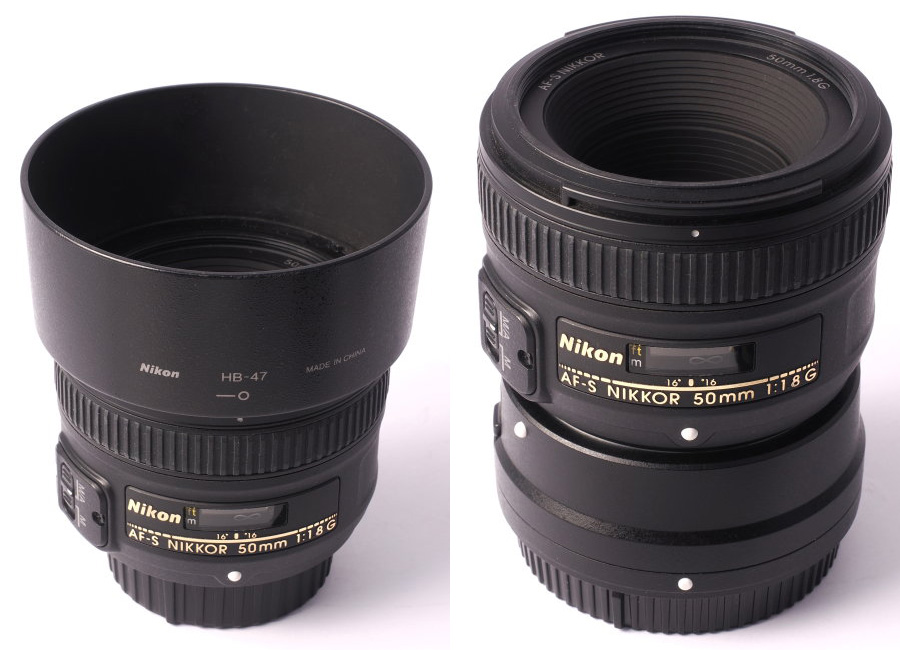
Like all G lenses, the AF-S 50 mm f/1.8 G lacks an aperture ring, but Z cameras can control all lens functions, including AF, via an FTZ or FTZ II lens adapter. I find AF with this lens on the Z8 is more than fast enough. This lens is equipped with an almost silent AF motor. When using AF, keep the shutter button half pressed and manually turn the focus ring of the lens to override AF (on the Z8, both in AF-C and AF-S modes, regardless of some photographers saying that this lens can manually override AF in AF-S mode, but not AF-C). The slider on the left side of the lens selects either M/A (i.e., AF with manual override) or M (MF only). The aperture range is f/1.8-f/16 (not f/22 like earlier models, which was fairly useless because of diffraction blur). This lens is not weather sealed, but is equipped with a rubber gasket around the lens mount that makes it more difficult for dust to enter the camera. The filter mount is attached to the external lens barrel, and neither rotates nor extends forward when focusing. Therefore, using a protector filter can help to keep dust, sand and moisture from fouling the lens internal mechanisms. The filter mount diameter is 58 mm, larger than the 52 mm typical of normal lenses in the various legacy AI series. With a protector filter in place, the focus ring is the main place where dust fouling can still occur. It looks pretty tight, but it is not dust- and water-proof. Some reviews describe this lens as having internal focus, but this is not correct. The optics move forward as a single block while focusing, including the front and rear optical elements. The front element is surrounded by what looks like a short lens shade, which also moves when focusing but does not reach the filter mount at the minimum focus distance. The closest focus distance is 45 cm, and the maximum magnification 0.15x. Some photographers complain about curvature of field at close focus with this lens (and with Nikon F 50 mm f/1.8 and 1.4 models in general), so it is probably not suitable for exacting close-up or repro imaging of flat subjects and printed materials. For three-dimensional subjects, especially in situations where the interesting part of the subject does not extend all the way to the image corners, and/or DOF can be increased by stopping down, this is less of a problem. The focus ring moves the distance scale, visible through a plastic window, slightly past the ∞ and closest marks, as common with modern lenses where focus can be affected by ambient temperature (this also cuts production costs, because a precise infinity focus calibration can be skipped). The DOF scale is reduced to two largely useless dots at f/16 only. The now obsolete NIR-focus mark is entirely missing. Lens weight is 185 g, which makes it one of the most lightweight AF-S lenses. The lens comes with a plastic HB-47 lens shade, which looks oversized for a 50 mm lens. The lens shade can be reversed onto the lens for storage, but in this position prevents access to the focus ring. In most situations, this lens shade is fairly useless, because the front element is deeply recessed within the filter mount at and near infinity focus. At close-up focus, the front element is surrounded by a miniature lens shade that moves with focus and provides a usually sufficient protection from direct illumination by the sun or strong light sources. In a pinch, without a lens shade the photographer can use his/her left hand to shelter the front lens element (with care not to photograph his/her own fingers) and prevent sunlight from causing flare. The lens bayonet is metal and not different from other AF-S lenses. The rest of the lens barrel is plastic but feels reasonably solid, with no wobbling parts because of the compact design and self-contained moving optical assembly that does not project from the front of the barrel. Some users complain of a slightly "gritty" feel when manually focusing, probably caused by the plastic-against-plastic movement of the focus ring. As a whole, this lens does not feel like a premium lens, but not like a "disposable" lens, either. Nikon did make some truly disposable zoom lenses with black plastic F bayonets for a few years around the turn of the century, then begun again with some of the cheapest consumer-level Z lenses, optically and price-wise interesting but equipped with plastic bayonets. Some of the Nikon 1 lenses even had chrome-plated plastic bayonets, which look like metal until they break, or until the plating peels away. To be fair, Nikon was not alone in making consumer lenses with plastic bayonets. I might be willing to pay more and get a better lens build quality, if I needed to use a 50 mm prime every day. Given that I need it rather infrequently and I may not take it on long trips, the quality and feel of this lens are quite adquate for the price I paid. Image quality

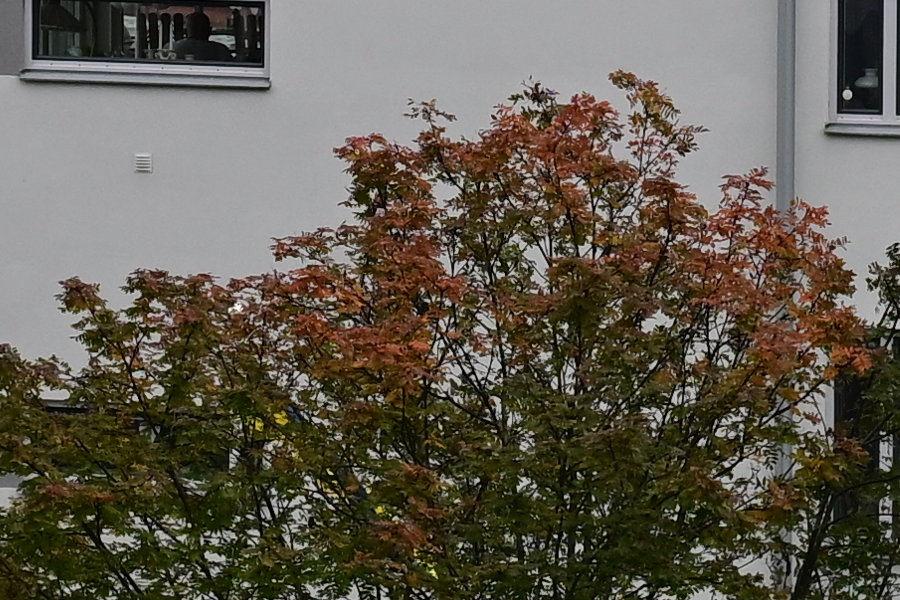
Figure 4 shows the test image, shot hand-held at f/1.8 on a dismally gray autumn day and reduced to 900 by 600 pixels for display. Figures 5-6 show a crop near the center of the frame, shot at f/1.8 and f/4, respectively. Best focus is on the building in the center, but both the tree in the foreground and an unaware neighbor, sitting at his table and visible through a window in the background, are in focus. This lens displays its best image quality at f/4, but is quite good between f/1.8 and f/5.6, considering that the crops in Figures 5-6 are only 1.2% of the total number of pixels of the original image. You can use f/8 to trade a little resolution for higher DOF. On a high-megapixel-count camera like the Nikon Z8, if high resolution is important you should stay away from f/11 and higher. On 24 Mpixel cameras, f/11 is still OK. Among types of aberrations that are difficult or impossible to automatically correct in-camera, the main problem of this lens is a visible amount of axial chromatic aberration. It largely disappears at f/8 and higher. Still, I find this image quality more than acceptable for a 90 € (+ shipment) AF lens. I have seen prices around 150 to 199 € for used specimens on eBay, but I think that anything above 120-130 € is excessive, given the abundance of used specimens, the need for an FTZ or FTZ II adapter for use on Z cameras, and that a new specimen can be bought from Nikon Sweden for around 235 € including sales tax and shipment. ConclusionsThe AF-S Nikkor 50 mm f/1.8 G is lightweight, relatively small, optically better than earlier f/1.8 models thanks to an aspheric element, and provides fast enough AF on the Nikon Z8. This lens is commonly available on the second-hand market, and reasonably priced. This is not a premium lens, but still works acceptably. Nikon Z users should not miss the aperture ring, since Z lenses also lack one. The AF-S Nikkor 50 mm f/1.8 G is the "normal" lens you want, if you are after a small and lightweight one of good optical quality, and are put off by the large size, weight and price of the current Nikon Z 50 mm f/1.4 and 1.8. This lens has a rubber gasket around the lens mount, but is not weather sealed. It is not an internal-focus lens, either. The filter mount is attached to the external barrel and does not extend with focus. A protector filter can be used to prevent dust and moisture from entering the lens around the front end of the moving internal barrel. The focus ring remains vulnerable to dust and moisture penetration. This lens is for photographers who can live without a detailed distance scale and depth-of-focus tick marks. The focus ring can feel slightly gritty even in unused specimens. Manual focus with this lens works well enough on the Z8 with focus peaking enabled. In single-AF mode, manual focus override is permanently enabled, and activated by turning the focus ring. However, AF on the Z8 is generally more reliable than MF. |